
Mathematics Of NBA Expected Value Betting
 Available in US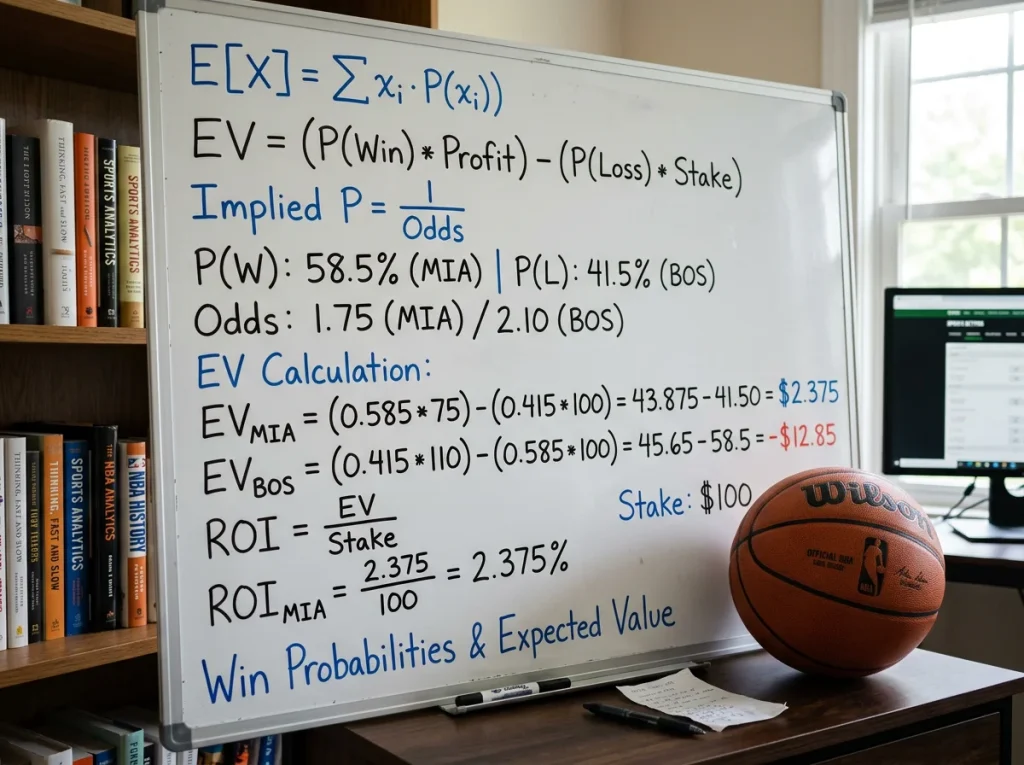
My top tip for prop betting is to focus on edges. Most days, the largest betting edges models identify belong to player prop bets rather than traditional moneylines, spreads or over/unders. There is virtually always great value to be found on props. That advice from professional analysts captures why expected value matters – prop markets are where the inefficiencies live, but finding them requires mathematical discipline.
Expected value is the concept that separates professional bettors from recreational ones. Recreational bettors ask “will this bet win?” Professional bettors ask “does this bet offer positive expected return over many repetitions?” The second question leads to sustainable profitability; the first leads to eventual ruin regardless of short-term results.
This guide breaks down expected value calculation for NBA props, explains how to apply it practically, and addresses the psychological challenges of betting for EV rather than outcomes.
Once you identify positive EV, tracking your NBA closing line value becomes the true measure of your long-term handicapping skill.
Calculating NBA Prop Expected Value
Expected value calculates your average return per bet if you could place the same wager infinitely many times. A positive expected value bet makes money on average even though individual instances may lose. A negative expected value bet loses money on average even when individual instances win. Long-term profitability requires consistently finding and betting positive EV.
The formula is straightforward: EV = (Probability of Winning × Amount Won) – (Probability of Losing × Amount Lost). For a £10 bet at even odds on a 55% probability outcome: EV = (0.55 × £10) – (0.45 × £10) = £5.50 – £4.50 = £1.00. Each such bet returns £1 on average despite losing 45% of the time.
Implied probability converts odds into the break-even winning percentage. At 10/11 odds (the standard UK prop price), implied probability equals about 52.4%. If you believe the actual probability exceeds 52.4%, the bet has positive EV. If your assessed probability is lower, the bet has negative EV regardless of how appealing the selection seems.
The gap between your probability assessment and the implied probability determines your edge size. A 55% assessment against 52.4% implied creates 2.6% edge. A 60% assessment creates 7.6% edge. Larger edges justify larger bets and tolerate more analytical uncertainty.
Calculating EV for Props
Practical EV calculation starts with probability estimation. For a points prop at over 24.5, what is the actual probability that this player scores 25 or more points? This question requires examining historical data, matchup factors, minutes projections, and situational context. The better your probability estimate, the more accurate your EV calculation.
Historical hit rates provide starting points. If a player has gone over 24.5 points in 58% of games this season, 58% represents a reasonable baseline probability. Adjust from there based on tonight’s specific circumstances – opponent defensive quality, player rest status, teammate availability.
Compare your final probability to the implied probability from the odds. If you estimate 58% and the odds imply 52.4%, you have calculated positive EV. The bet offers value. If you estimate 51% against 52.4% implied, the bet has negative EV despite your belief that the over is more likely than not.
Quantify your edge in percentage terms. A 58% estimate against 52.4% implied represents 5.6 percentage points of edge. This quantification helps with bet sizing – larger edges justify larger bets within your bankroll management framework.
Document your calculations for later review. Recording your probability estimates and reasoning creates a feedback loop. After games conclude, you can see whether your estimates were accurate or whether systematic biases affect your analysis.
Compare odds and read detailed reviews on the best NBA props guide for UK bettors.
Common EV Mistakes
Confusing likely outcomes with valuable bets represents the most common error. A player might have 65% probability of hitting their prop, making the over a likely winner. But if the odds imply 68% probability, the bet has negative EV despite being more likely to win than lose.
Overconfidence in probability estimates produces false positive EV. If you consistently estimate probabilities 3-5% higher than reality, you will calculate positive EV on bets that are actually negative. Track your estimates against outcomes to identify and correct systematic bias.
Ignoring the vig when assessing value creates illusions. Standard prop juice of 10/11 on both sides means you need roughly 52.4% accuracy to break even, not 50%. Always calculate against implied probability including the margin, not against a theoretical fair line.
Anchoring to bet outcomes rather than process quality derails improvement. A winning bet placed at negative EV was still a mistake. A losing bet placed at positive EV was correct even though it lost. Evaluate your betting based on whether your process identified genuine edge.
Chasing losses by betting negative EV to recover accelerates destruction. When behind for a session, the temptation is to place bigger bets to get even. This approach guarantees long-term losses because you are compounding negative EV. Discipline means accepting losses when no positive EV exists.
Frequently Asked Questions
How do I calculate expected value for NBA props?
EV = (Your Probability × Potential Profit) – (1 – Your Probability × Stake). Estimate the true probability of an outcome, then compare to implied probability from the odds. If your probability exceeds implied probability, the bet has positive EV.
What edge do I need for profitable prop betting?
Any positive edge compounds over time, but practical considerations matter. Edges below 2% are hard to verify statistically. Edges of 3-5% provide meaningful value. Edges above 5% are rare and warrant increased confidence before betting.
Why do professional bettors focus on expected value rather than winning percentage?
Winning percentage without considering odds is meaningless. A 70% winner at odds implying 75% loses money. A 52% winner at odds implying 50% makes money. Expected value captures the relationship between probability and odds that determines profitability.
Building an EV-Focused Approach
Transitioning to EV-based betting requires rewiring how you think about success. Celebrate correctly-placed bets rather than winning bets. Accept that losing nights happen even when every decision was sound. This psychological shift feels unnatural initially but becomes comfortable with practice over several months of disciplined application.
Start by calculating EV on every bet before placement, even if rough estimates. The discipline of running the calculation catches obvious mistakes and builds the habit of thinking in expected value terms. Over time, the calculations become faster and more intuitive until they feel like second nature.
Track results in EV terms alongside actual profit/loss. You might have a losing month while making positive EV bets throughout – variance working against you temporarily. You might also have a winning month driven by luck rather than edge. Both perspectives inform your understanding of what is actually happening beneath surface results.
Build a spreadsheet logging your probability estimates, implied probability from odds, calculated edge, and actual outcomes. Review this data weekly to identify patterns in your analysis. The feedback loop accelerates improvement far faster than intuition alone allows.
Connect with other EV-focused bettors to validate your thinking and learn alternative approaches. The betting community includes serious handicappers willing to discuss methodology and share insights. These conversations sharpen your understanding of expected value concepts and catch blind spots in your analytical process that working alone might miss.
Remember that EV thinking applies to every betting decision, not just prop selection. Bankroll sizing, bookmaker choice, timing of bets, and promotional usage all have expected value implications. Extending EV discipline across your entire betting operation maximises the benefits of this mathematical framework.
